2025/11 - 2025/12
2025/11 - 2025/12
TTC Website Redesign
TTC Website Redesign
Overview
Overview
The TTC website’s structure makes it difficult to efficiently access key transit information.
This project improves the information architecture and interface to create a clearer, more efficient experience.
The TTC website’s structure makes it difficult to efficiently access key transit information.
This project improves the information architecture and interface to create a clearer, more efficient experience.
My role
My role
• Identifying key user tasks
• Designing the information architecture
• Homepage redesign
• Identifying key user tasks
• Designing the information architecture
• Homepage redesign
Team
Team
Jennifer Jiang
Chonlawat Rojanawisit
Nathan Richards
Nhu Hua
Jennifer Jiang
Chonlawat Rojanawisit
Nathan Richards
Nhu Hua

Why redesign the TTC website?
Why redesign the TTC website?
The TTC website contains a large amount of transit information, but the way content is grouped and structured is not always intuitive. In some cases, unrelated information appears within the same section, making it difficult for users to understand where to find what they need.
Additionally, certain navigation paths lead to pages filled with multiple links, creating a deep and fragmented information hierarchy. While users are still able to find key information such as routes, fares, and service updates, the process is often inefficient and requires unnecessary effort.
The TTC website contains a large amount of transit information, but the way content is grouped and structured is not always intuitive. In some cases, unrelated information appears within the same section, making it difficult for users to understand where to find what they need.
Additionally, certain navigation paths lead to pages filled with multiple links, creating a deep and fragmented information hierarchy. While users are still able to find key information such as routes, fares, and service updates, the process is often inefficient and requires unnecessary effort.
How did we approach the problem?
How did we approach the problem?
To understand the problem, we combined structural analysis, user testing, and task-based evaluation to identify where users experience friction.
To understand the problem, we combined structural analysis, user testing, and task-based evaluation to identify where users experience friction.
This process included:
Step #1 – Conducting a current website analysis to identify usability and navigation issues
Step #1 – Conducting a current website analysis to identify usability and navigation issues
Current website analysis
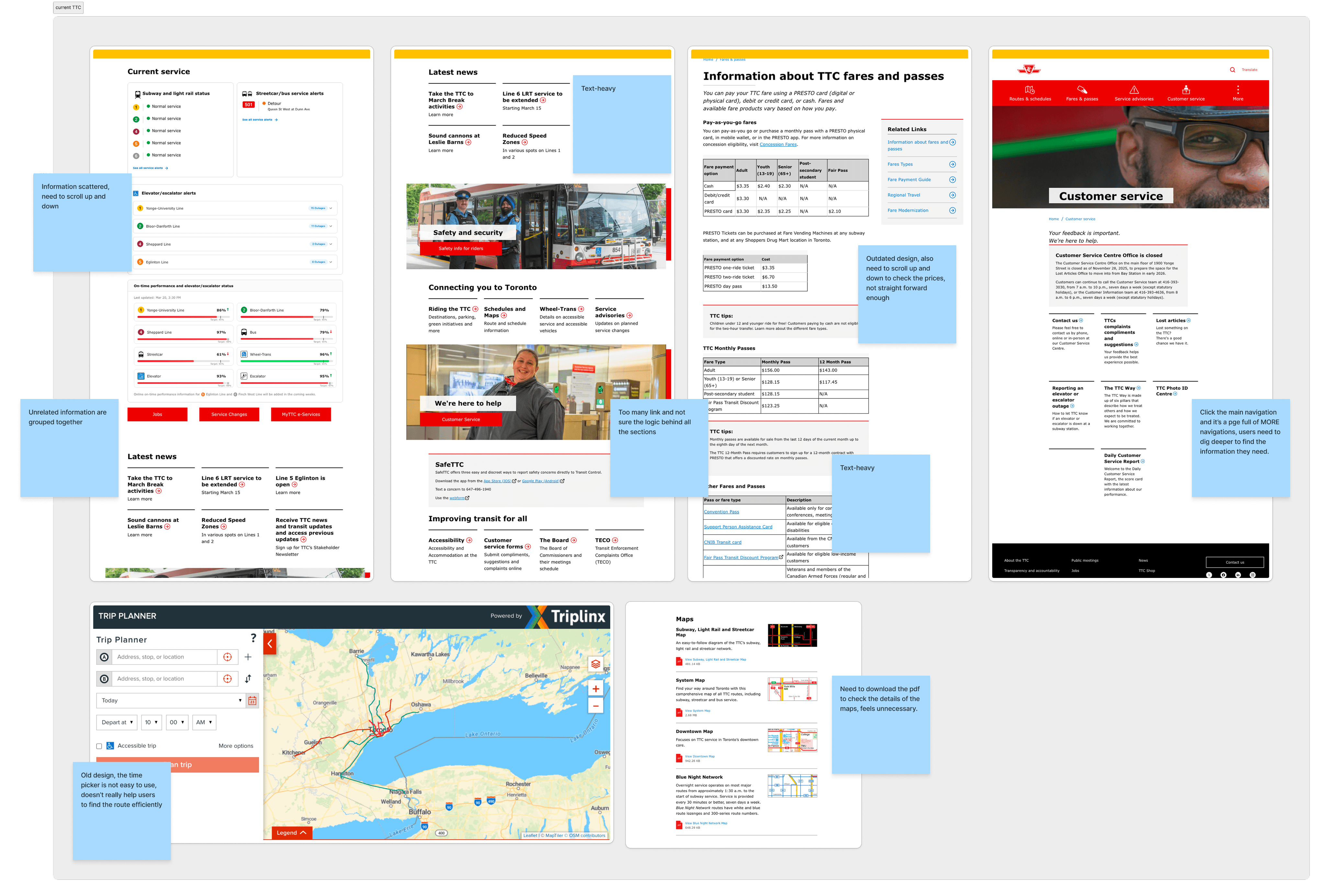
→ We analyzed the current TTC website to understand how information is structured and presented across key pages.
This process revealed several usability issues, including information overload, unclear grouping, and inconsistent navigation, making it difficult for users to quickly understand where to go.
→ We analyzed the current TTC website to understand how information is structured and presented across key pages.
This process revealed several usability issues, including information overload, unclear grouping, and inconsistent navigation, making it difficult for users to quickly understand where to go.
Step #2 – Mapping the existing information architecture to understand how content is structured
Step #2 – Mapping the existing information architecture to understand how content is structured
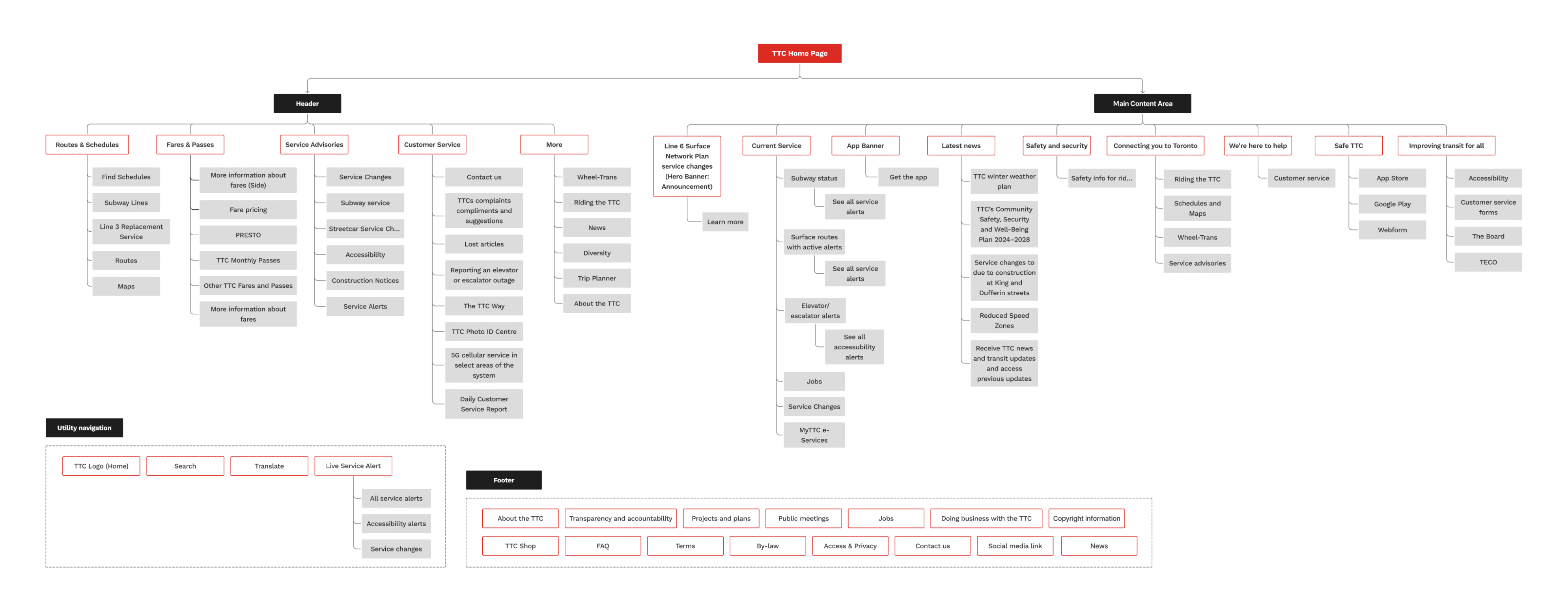
Information architecture for current TTC website
IA for current TTC website
Information architecture for current TTC website
→ To understand the structure of the TTC website, I mapped out the existing information architecture. This helped reveal how content is grouped and how users are expected to navigate the site.
→ To understand the structure of the TTC website, I mapped out the existing information architecture. This helped reveal how content is grouped and how users are expected to navigate the site.
Through this process, several structural issues became clear:
🚩 The main content area contains too many links, creating visual clutter and making it difficult to scan
🚩 Some navigation labels are long or unclear, making it harder to quickly understand where to go
🚩 Information is not always grouped logically — for example, unrelated content such as jobs appears under the “Current Service” section
🚩 The overall structure creates a deep hierarchy, requiring users to navigate through multiple layers to find key information
Through this process, several structural issues became clear:
🚩 The main content area contains too many links, creating visual clutter and making it difficult to scan
🚩 Some navigation labels are long or unclear, making it harder to quickly understand where to go
🚩 Information is not always grouped logically — for example, unrelated content such as jobs appears under the “Current Service” section
🚩 The overall structure creates a deep hierarchy, requiring users to navigate through multiple layers to find key information
Step #3 – Defining key user tasks based on common user needs
Step #3 – Defining key user tasks based on common user needs
We defined key user tasks based on common goals, focusing on what users typically visit the TTC website to accomplish. These tasks guided both testing and design decisions.
We defined key user tasks based on common goals, focusing on what users typically visit the TTC website to accomplish. These tasks guided both testing and design decisions.
Task 1
Task 1
Find fare information for a single Adult.
Find fare information for a single Adult.
Task 2
Task 2
Find where they post general service updates.
Find where they post general service updates.
Task 3
Task 3
Plan a trip from Union Station to Royal Ontario Museum for Saturday, November 8, 2025.
Plan a trip from Union Station to Royal Ontario Museum for Saturday, November 8, 2025.
Step #4 – Running user testing to observe user behavior and pain points
Step #4 – Running user testing to observe user behavior and pain points
Using these tasks, we conducted user testing to observe real user behavior. The results highlighted issues in navigation, unclear information grouping, and friction in completing common tasks.
Using these tasks, we conducted user testing to observe real user behavior. The results highlighted issues in navigation, unclear information grouping, and friction in completing common tasks.
Task 1
Task 1
Task 1
Find the fare price for a Single Adult
Find the fare price for a Single Adult
Find the fare price for a Single Adult
Completion rate
Completion rate
Completion rate
100%
100%
100%
Time on task
Time on task
Time on task
19s
19s
19s
Average SEQ
Average SEQ
Average SEQ
6.5
6.5
6.5
Task 2
Task 2
Task 2
Find where they post general service updates.
Find where they post general service updates.
Find where they post general service updates.
Completion rate
Completion rate
Completion rate
91.7%
91.7%
91.7%
Time on task
Time on task
Time on task
28s
28s
28s
Average SEQ
Average SEQ
Average SEQ
6
6
6
Task 3
Task 3
Task 3
Plan a trip from Union Station to Royal Ontario Museum for Saturday, November 8, 2025.
Plan a trip from Union Station to Royal Ontario Museum for Saturday, November 8, 2025.
Plan a trip from Union Station to Royal Ontario Museum for Saturday, November 8, 2025.
Completion rate
Completion rate
Completion rate
33.4%
33.4%
33.4%
Time on task
Time on task
Time on task
03m:58s
03m:58s
03m:58s
Average SEQ
Average SEQ
Average SEQ
1
1
1
(very hard!)
(very hard!)
(very hard!)
User testing results for current TTC website
Testing results for current TTC website
User testing results for current TTC website
“Do I need to buy this Presto card just for one weekend? Oh wait, I can just tap my credit card. That took a minute to figure out.🧐” — Tester #1
“Do I need to buy this Presto card just for one weekend? Oh wait, I can just tap my credit card. That took a minute to figure out.🧐” — Tester #1
“I see lists of delays here, but I don't know if 'Keele Station' is near where I'm going, so I'm not sure if this affects me.🤔” — Tester #2
“I see lists of delays here, but I don't know if 'Keele Station' is near where I'm going, so I'm not sure if this affects me.🤔” — Tester #2
“The trip planner is really obsolete.😵” — Tester #3
“The trip planner is really obsolete.😵” — Tester #3
“I know I just need to take Line 1 North to Museum station. The planner is painfully slow compared to just knowing the route.😩” — Tester #3
“I know I just need to take Line 1 North to Museum station. The planner is painfully slow compared to just knowing the route.😩” — Tester #3
“It was confusing where to find where I could plan.🤨”
— Tester #1
“It was confusing where to find where I could plan.🤨”
— Tester #1
Step #5 – Creating user flows based on the current experience to identify inefficiencies in task completion
Step #5 – Creating user flows based on the current experience to identify inefficiencies in task completion
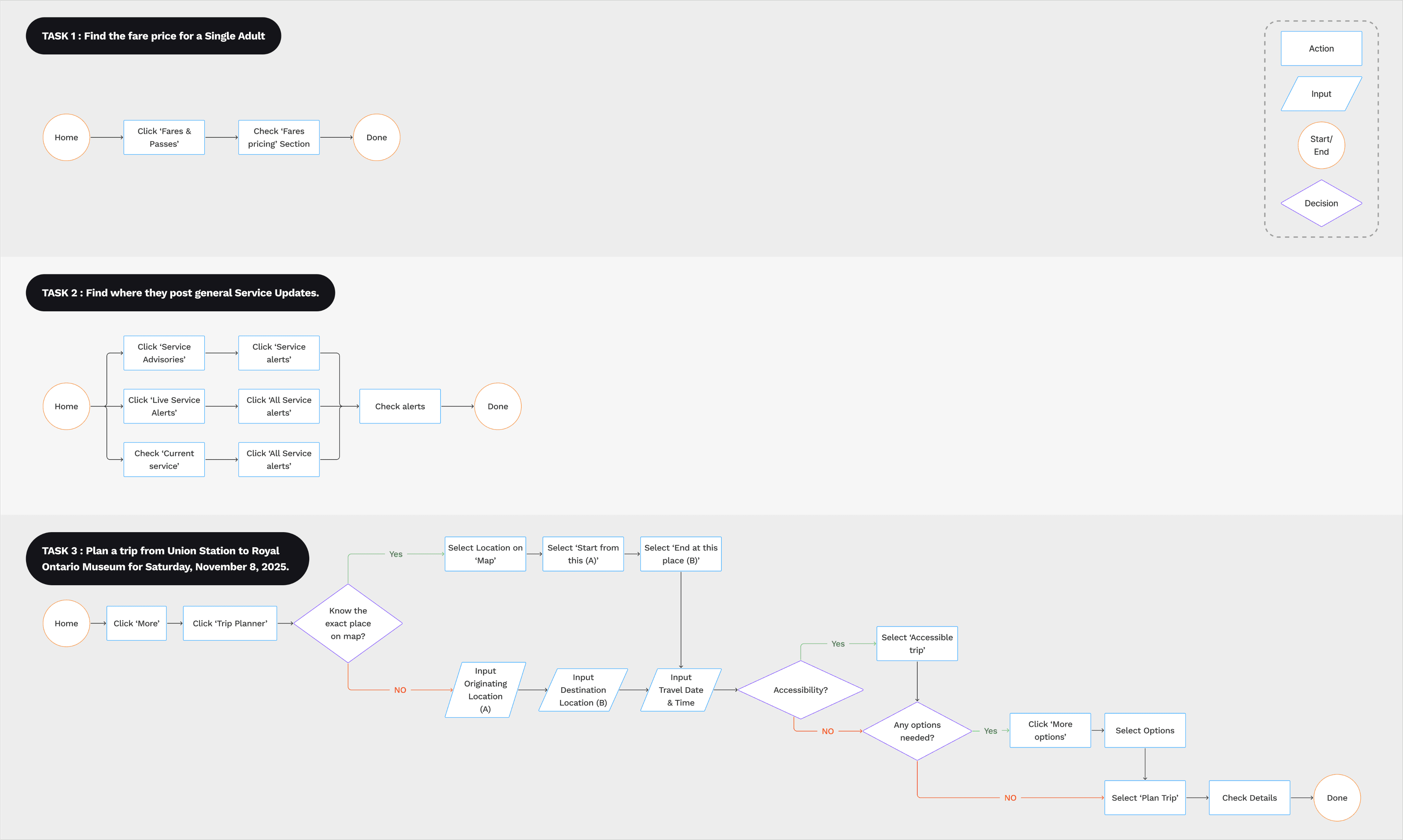
User flows for each task
User flows for each task
User flows for each task
→ We mapped user flows based on the current experience to understand how users complete key tasks.
→ We mapped user flows based on the current experience to understand how users complete key tasks.
Although the flows are relatively simple, the homepage contains a large amount of unprioritized information, making it difficult for users to identify where to start. As a result, users often navigate through unnecessary content before reaching their goal.
This highlights that the main issue lies in the information architecture, rather than task complexity.
Although the flows are relatively simple, the homepage contains a large amount of unprioritized information, making it difficult for users to identify where to start. As a result, users often navigate through unnecessary content before reaching their goal.
This highlights that the main issue lies in the information architecture, rather than task complexity.
Key Insights
Key Insights
The research findings revealed several key insights that guided the redesign:
The research findings revealed several key insights that guided the redesign:
🔴 Unclear information grouping creates confusion
Information is not always grouped intuitively, with unrelated content appearing under the same sections (e.g., jobs under service updates). This makes navigation unpredictable and harder to understand.
🔴 Unclear information grouping creates confusion
Information is not always grouped intuitively, with unrelated content appearing under the same sections (e.g., jobs under service updates). This makes navigation unpredictable and harder to understand.
🔴 Lack of prioritization makes it difficult to find entry points
The homepage presents a large amount of information without clear hierarchy, making it difficult for users to quickly identify where to start.
🔴 Lack of prioritization makes it difficult to find entry points
The homepage presents a large amount of information without clear hierarchy, making it difficult for users to quickly identify where to start.
🔴 The issue is not complexity, but clarity!
Although user flows are relatively simple, users struggle to interpret information and locate the right path. The experience requires unnecessary effort due to unclear structure and information design.
🔴 The issue is not complexity, but clarity!
Although user flows are relatively simple, users struggle to interpret information and locate the right path. The experience requires unnecessary effort due to unclear structure and information design.
How did we redesign?
How did we redesign?
Based on the key insights, the redesign focused on:
Based on the key insights, the redesign focused on:
Improving clarity
Improving clarity
Simplifying navigation
Simplifying navigation
Restructuring the IA around users’ primary needs
Restructuring the IA around users’ primary needs
We reorganized the content based on key user tasks, ensuring that essential actions such as checking routes, viewing service updates, and planning a trip are easier to access. The new structure reduces unnecessary steps and creates a more intuitive navigation experience.
At the same time, the homepage was redesigned to prioritize important information and provide clearer entry points, helping users quickly understand where to start and how to proceed.
We reorganized the content based on key user tasks, ensuring that essential actions such as checking routes, viewing service updates, and planning a trip are easier to access. The new structure reduces unnecessary steps and creates a more intuitive navigation experience.
At the same time, the homepage was redesigned to prioritize important information and provide clearer entry points, helping users quickly understand where to start and how to proceed.
Redesign process included:
Step #1 – Redesigning the information architecture based on key user tasks
Step #1 – Redesigning the information architecture based on key user tasks
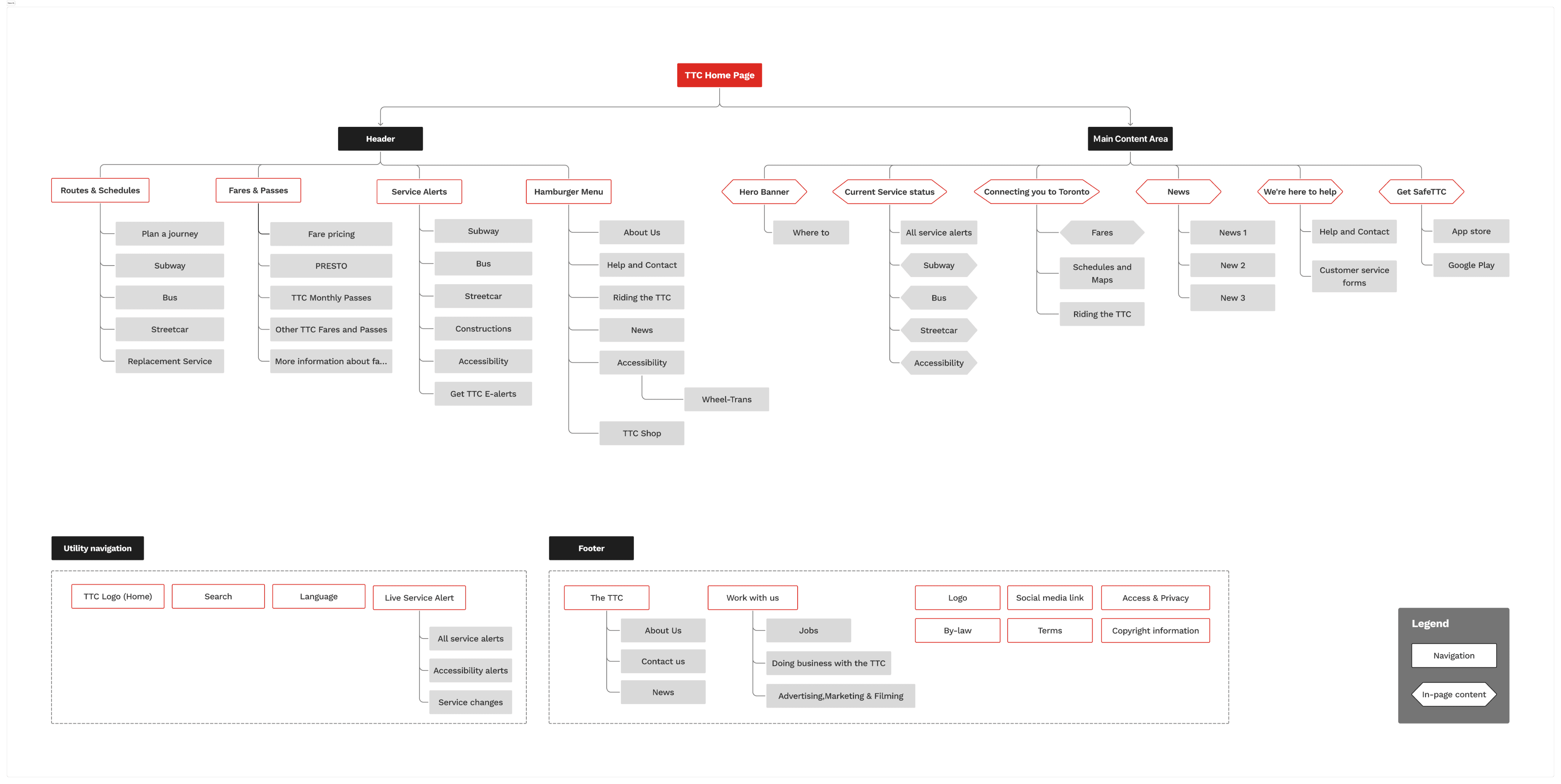
Information architecture for new TTC website
IA for new TTC website
Information architecture for new TTC website
→ Based on the identified user needs, I restructured the information architecture to better align with how users approach the TTC website.
→ Based on the identified user needs, I restructured the information architecture to better align with how users approach the TTC website.
Content was reorganized around key tasks such as checking routes, checking prices, viewing service updates, and planning a trip. This helped reduce unnecessary layers and made navigation more intuitive and predictable.
Content was reorganized around key tasks such as checking routes, checking prices, viewing service updates, and planning a trip. This helped reduce unnecessary layers and made navigation more intuitive and predictable.
Step #2 – Redesigning the homepage to provide clearer entry points
Step #2 – Redesigning the homepage to provide clearer entry points
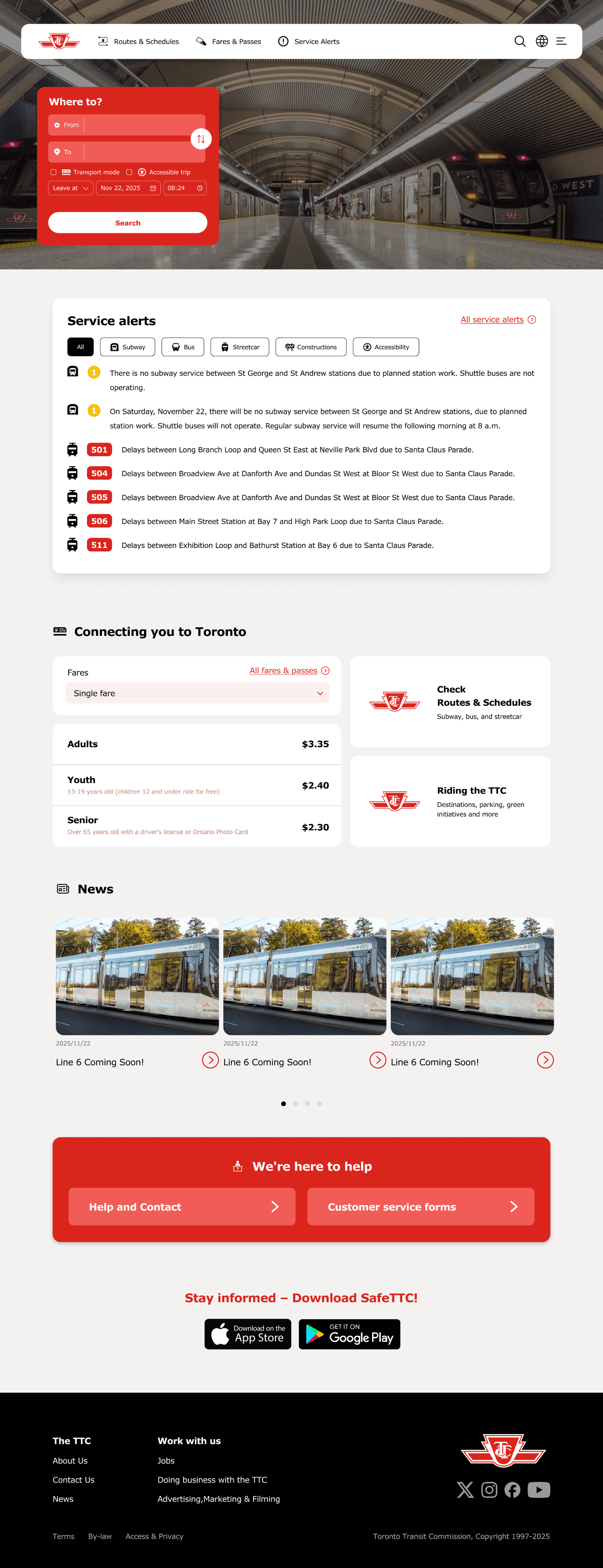
New TTC website - Homepage
New TTC website - Homepage
Scroll to see details
Scroll to see details
→ With the new structure in place, I redesigned the homepage to better prioritize essential information and guide users toward key actions.
→ With the new structure in place, I redesigned the homepage to better prioritize essential information and guide users toward key actions.
The new layout reduces visual clutter, highlights important content, and creates clearer entry points, allowing users to quickly understand where to start and how to proceed.
The new layout reduces visual clutter, highlights important content, and creates clearer entry points, allowing users to quickly understand where to start and how to proceed.
Step #3 – Validating the redesign through user testing
Step #3 – Validating the redesign through user testing
To evaluate the effectiveness of the redesign, we conducted another round of user testing based on the same key tasks.
The results showed that users were able to navigate more efficiently, identify entry points more quickly, and complete tasks with less effort, indicating improvements in clarity and overall usability.
To evaluate the effectiveness of the redesign, we conducted another round of user testing based on the same key tasks.
The results showed that users were able to navigate more efficiently, identify entry points more quickly, and complete tasks with less effort, indicating improvements in clarity and overall usability.
Task 1
Task 1
Task 1
Find the fare price for a Single Adult
Find the fare price for a Single Adult
Find the fare price for a Single Adult
Completion rate
Completion rate
Completion rate
100% → 100%
100% → 100%
100% → 100%
Time on task
Time on task
Time on task
19s → 17s
19s → 17s
19s → 17s
Average SEQ
Average SEQ
Average SEQ
6.5 → 7
6.5 → 7
6.5 → 7
Task 2
Task 2
Task 2
Find where they post general service updates.
Find where they post general service updates.
Find where they post general service updates.
Completion rate
Completion rate
Completion rate
91.7% → 100%
91.7% → 100%
91.7% → 100%
Time on task
Time on task
Time on task
28s → 18s
28s → 18s
28s → 18s
Average SEQ
Average SEQ
Average SEQ
6 → 7
6 → 7
6 → 7
Task 3
Task 3
Task 3
Plan a trip from Union Station to Royal Ontario Museum for Saturday, November 8, 2025.
Plan a trip from Union Station to Royal Ontario Museum for Saturday, November 8, 2025.
Plan a trip from Union Station to Royal Ontario Museum for Saturday, November 8, 2025.
Completion rate
Completion rate
Completion rate
33.4% → 100%
33.4% → 100%
33.4% → 100%
Time on task
Time on task
Time on task
03m:58s → 18s
03m:58s → 18s
03m:58s → 18s
Average SEQ
Average SEQ
Average SEQ
1
1
1
→ 7
→ 7
→ 7
User testing results for new TTC website
Testing results for new TTC website
User testing results for new TTC website
“Wow! It is rare for the TTC site to be this user-friendly🤩” — Tester #1
“Wow! It is rare for the TTC site to be this user-friendly🤩” — Tester #1
“Everything I need is right here. I don’t have to look around anymore.😆” — Tester #2
“Everything I need is right here. I don’t have to look around anymore.😆” — Tester #2
“Planning a trip feels straightforward now. I didn’t get lost like before.🤓” — Tester #3
“Planning a trip feels straightforward now. I didn’t get lost like before.🤓” — Tester #3
“OH the fare information is easier to understand now.😙” — Tester #3
“OH the fare information is easier to understand now.😙” — Tester #3
“ts so easy, its the first thing you see.😌”
— Tester #1
“ts so easy, its the first thing you see.😌”
— Tester #1
What was the impact?
What was the impact?
The redesign made it easier for users to navigate the TTC website and access key information.
The redesign made it easier for users to navigate the TTC website and access key information.
Users were able to
Users were able to
Identify entry points quickly
Identify entry points quickly
Complete tasks efficiently
Complete tasks efficiently
Spend less time interpreting information
Spend less time interpreting information
While the number of steps did not change significantly, users were able to complete tasks faster and with greater confidence.
While the number of steps did not change significantly, users were able to complete tasks faster and with greater confidence.
Before v.s. After
Before v.s. After
New TTC website - Homepage
Old design
New design
New TTC website - Homepage
Old design
New design
New TTC website - Homepage
Old design
New design
Prototype Demo
Prototype Demo
💡 The biggest improvement was not reducing steps, but reducing the effort required to understand where to go.
💡 The biggest improvement was not reducing steps, but reducing the effort required to understand where to go.
What did I learn?
What did I learn?
This project showed me how strongly information architecture shapes the user experience. Even when tasks are simple, unclear structure and lack of prioritization can significantly increase user effort.
It also reinforced the importance of designing for clarity — helping users quickly understand where to start, rather than simply reducing the number of steps.
This project showed me how strongly information architecture shapes the user experience. Even when tasks are simple, unclear structure and lack of prioritization can significantly increase user effort.
It also reinforced the importance of designing for clarity — helping users quickly understand where to start, rather than simply reducing the number of steps.
💡 Ultimately, the challenge was not complexity, but clarity.
💡 Ultimately, the challenge was not complexity, but clarity.

© Jennifer Jiang, 2026